Day one
Your first Monday.
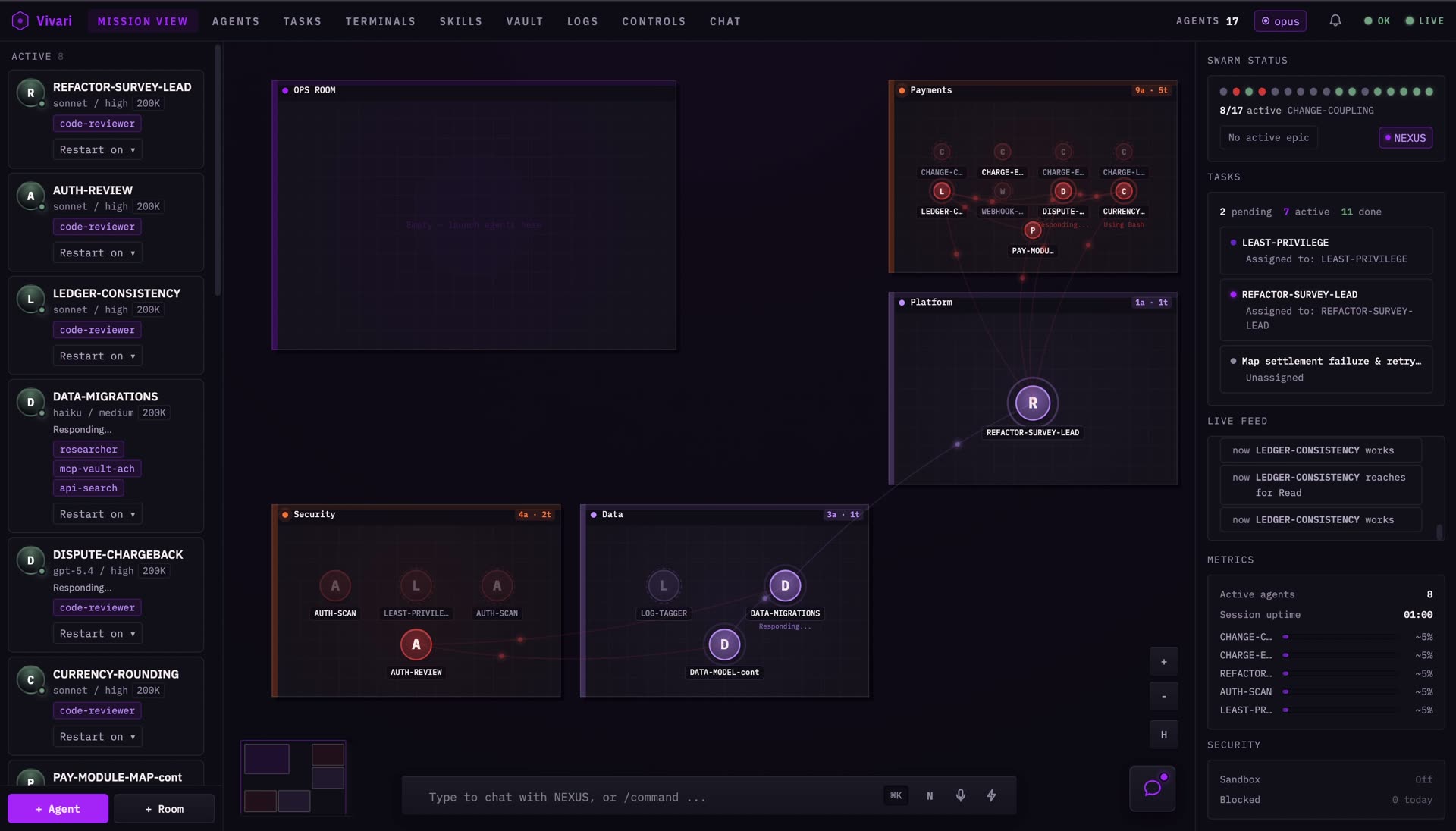
9:04. You open Vivari to the agent you left mid-task on Friday: still in its room, still on budget, every step on the record. You are caught up in ten seconds. Then you widen the view, and the whole room comes into frame. No standup required.
The Conductor has been working between your prompts. It brings finished work for your eyes, and one thing it would not decide alone: a risky change, flagged teal, held until a human clears it. That human is you. You read the diff.
You clear it, or you take the wheel and finish it your way. Either way the decision is filed with the reason. By 9:30 the fleet is moving again, and the whole morning is one search away for as long as you need it.
What is Vivari?
Vivari is the AI agent workspace: a living, observed environment where fleets of AI agents are put to work and kept accountable at the magnification you choose. Engineering agents ship code, research agents map a market, ops agents run the pipeline. It is the management layer for AI agents: context, shared memory, scoped permissions, deterministic safety review, full audit trails, and a human who can always take the wheel.
The idea is old. We just never applied it to agents. Organizations already know how to absorb a brilliant stranger: onboard them, scope their access to their role, review their early work closely, keep records, and keep a senior nearby. Vivari gives your agents exactly that, in one workspace. It runs the agents you already use (Claude Code, Codex, Cursor today, plus local and custom OpenAI-compatible models through the same harnesses), and shipping code is only the first job you'll hire them for:
- L1The fleet, every room and agent at one glance: live tasks, burn, and whatever is waiting on you. See it live →
- L2The rooms, where the same Claude Code, Codex, and Cursor sessions you already run open with their own context and scope. Your hands on the keys whenever you want them.
- L3The policies, enforced under every room: roles set each agent's bounds, a rule-based evaluator escalates high-risk actions to a human, and Vivari Guard judges risky changes with evidence from a deep map of your whole codebase. How Guard decides →
- L4Command, where you and the Conductor run the fleet: a brainstormer drafts while agents work, a curator reviews before anything reaches you. It brings you finished work instead of waiting to be asked.
- L5The Brain, living shared memory with retrieval judgment: agents are born knowing your project and write back what they learn. Why memory is judgment →
You move between them the way deep strategy games move you: full pages when you want them, one continuous camera when you don't, and a shortcut you can summon from anywhere to jump straight to any of them. Hold V right now and try it on this page.
“A prompt is a sticky note. Onboarding is a map.”Wael Masri, founder
Plenty of tools can run many agents at once. The product is keeping each one accountable. The parts demos skip (memory with judgment, deterministic review, metered attention and cost, an audit trail that answers to you) are the parts we built first. The method explains each.